

Digital Transformation Courses
Home – Executive Programs – Certifications
Get Your Brochure

2 Case Studies

Live Sessions

2 Assignments

Certificate of Completion
Course Overview
Digital transformation certification programme is created and delivered by tryBusinessAgility, an executive education organisation known for outcome-focused learning. The course structure reflects real organisational environments where strategy, people, process, and technology intersect daily. Participants gain clarity on how digital initiatives influence revenue models, operating structures, customer experience, and leadership accountability.
The programme avoids tool-centric teaching. Attention stays on business judgement, leadership decisions, and execution discipline. Participants explore how data, platforms, automation, and AI influence organisational capability without turning the course into a technical classroom.
The certification functions as a parent programme that supports multiple professional roles. Executives, leaders, managers, business owners, and corporate teams learn through a shared framework while applying insights to their own responsibilities. This structure creates alignment across leadership layers and functional teams.
Learning sessions combine instruction, discussion, case analysis, and reflection. Faculty bring experience from banking, telecom, payments, product development, and large enterprise environments. Examples and discussions reflect Indian market realities, regulatory conditions, and organisational culture.
By the end of the programme, participants gain a structured view of digital transformation as a continuous leadership practice. The course prepares professionals to participate confidently in strategy discussions, investment decisions, and transformation initiatives within their organisations.
Professional Digital Transformation Courses by Industry
Digital transformation impacts every role in an organisation differently. Senior executives focus on vision and investment choices, leaders manage alignment and change, managers drive execution, business owners seek growth, and corporate teams ensure consistency at scale. A single learning approach cannot address all these needs effectively.
This certification programme is structured as a parent course with role-specific learning paths. Each path shares a common transformation framework while addressing responsibilities, challenges, and decision authority unique to each role. This structure supports shared understanding across organisations while allowing depth where it matters most.

Digital Transformation For Executives Course
The executive learning path focuses on strategic ownership and enterprise-wide impact. Senior leaders often approve investments, set priorities, and carry accountability for outcomes. Digital initiatives fail when leadership lacks clarity on value, risk, and sequencing.
Course Details
Participants in this course explore how digital strategy connects with business objectives, capital planning, and organisational capability. Sessions focus on enterprise architecture choices, portfolio governance, and balancing innovation with stability. Discussions include mergers, partnerships, vendor ecosystems, and regulatory considerations relevant to Indian enterprises.
The programme strengthens board-level conversations by building shared language around data, platforms, AI, and operating models. Executives leave with clearer judgement on where to invest, what to stop, and how to measure progress without relying solely on technical teams.
Digital Transformation For Leaders Course
Leaders operate between strategy and execution. They translate intent into action while managing people, processes, and performance expectations. This learning path supports functional heads, business unit leaders, and transformation leads.
Course Details
Participants learn how digital initiatives affect team structures, workflows, and accountability. The course addresses challenges such as resistance to change, cross-functional dependency, and competing priorities. Leadership communication, stakeholder management, and decision alignment receive focused attention.
Case discussions reflect scenarios from operations, finance, HR, marketing, and technology leadership roles. Leaders gain confidence in guiding teams through change while maintaining performance discipline.
Digital Transformation For Managers Course
Managers are responsible for day-to-day execution. Digital initiatives often add pressure without clear direction, leading to delivery fatigue. This learning path focuses on practical execution clarity. This helps to understand the importance and potential of digital transformation
Course Details
Participants learn how to work with agile delivery models, data-driven decision practices, and technology teams. The programme addresses planning, prioritisation, performance tracking, and issue escalation within transformation programmes.
Managers gain tools to support team readiness, manage delivery risks, and contribute meaningfully to transformation goals. The learning approach respects operational realities faced by middle management across industries.
Digital Transformation For Business Course
Business owners and entrepreneurs approach digital transformation with growth and sustainability in mind. This learning path supports founders, partners, and senior business decision-makers.
Course Details
Participants explore how digital capabilities influence customer acquisition, service models, pricing, and scalability. The course addresses digital product thinking, platform choices, and operational efficiency without excessive technical detail.
Examples reflect small and mid-sized businesses operating in competitive Indian markets. Participants gain clarity on where digital investment creates value and where it adds unnecessary cost.
Digital Transformation For Corporate Course
Large organisations require alignment across functions, regions, and teams. The corporate learning path supports shared understanding and coordinated execution.
Course Details
This course focuses on enterprise governance, capability building, and collaboration across departments. Participants learn how to structure transformation offices, define success metrics, and manage vendor partnerships.
Corporate teams use this path to build common language and shared priorities. The outcome supports faster decision-making and consistent execution across the organisation.
Who Should Enroll
Digital transformation affects professionals across leadership levels and functions. This certification programme is structured to support individuals who influence strategy, execution, or organisational change, regardless of industry or technical background.

Senior Executives and Board Members
Senior executives gain clarity on digital investment decisions, enterprise priorities, and long-term capability building. The programme supports CXOs, board members, and senior leaders responsible for growth, governance, and organisational resilience, helping them evaluate initiatives with confidence and align leadership teams around strategic outcomes.

Functional and Business Leaders
Functional and business leaders benefit from understanding how digital initiatives impact people, processes, and performance. The programme is well suited for heads of operations, finance, HR, marketing, technology, and transformation offices who must lead teams through change while continuing to meet business and performance targets.

Managers and Operational Leaders
Managers involved in delivery and day-to-day operations gain practical insights into execution discipline. The course supports managers responsible for programmes, products, services, or operational units, helping them work effectively with digital teams, data, and agile practices without losing control over outcomes and accountability.

Business Owners and Entrepreneurs
Business owners, founders, and entrepreneurs benefit from a structured view of digital capability. The programme supports decision-making related to customer experience, service design, and scalable operations, offering clarity on where digital investment directly enables growth, efficiency, and sustainability.

Consultants and Transformation Professionals
Consultants, advisors, and transformation professionals find the certification valuable for building a shared language with clients and stakeholders. The programme strengthens credibility by grounding recommendations in practical frameworks and real business contexts rather than tool-specific or purely technical knowledge.

Corporate Teams and Participant Readiness
The course does not require prior technical expertise; professionals with exposure to business operations, leadership responsibilities, or strategic planning gain the most value. Curiosity, openness to change, and a willingness to reflect on current practices support strong learning outcomes.
What Skills Will You Gain from This Course?
The Digital Transformation Certification Training builds practical skills that support leadership effectiveness, execution clarity, and long-term organisational capability. The programme focuses on strengthening judgement, communication, and decision-making rather than tool dependency. Participants leave with skills that apply across roles, industries, and organisational contexts.
- Digital Strategy and Business Alignment: Participants develop the ability to connect digital initiatives with business goals. The course builds clarity on how strategy, operating models, and technology choices influence growth, efficiency, and customer trust. This skill supports better prioritisation and reduces fragmented digital efforts.Learners gain confidence in evaluating digital proposals, questioning assumptions, and aligning initiatives with organisational direction. Strategy discussions become clearer and more outcome-focused.
- Leadership and Change Capability: Digital transformation requires leadership ownership at every level. The programme strengthens leadership communication skills needed to guide teams through change. Participants learn how to explain intent, manage resistance, and maintain momentum during transformation efforts. The course supports leaders in building trust, encouraging accountability, and setting clear expectations. These skills help sustain performance while introducing new ways of working.
- Data-Informed Decision Making: Participants learn how data supports better business decisions without turning leaders into analysts. The programme explains how metrics, dashboards, and insights influence planning, performance tracking, and risk management. This skill helps professionals ask the right questions, interpret trends, and avoid decisions based solely on intuition. Leaders gain confidence in using data as a regular input to decision-making.
- Understanding Digital and Technology Concepts: The course builds foundational understanding of digital platforms, cloud, automation, and AI from a business perspective. Participants learn how these elements influence cost structures, scalability, and customer experience. This knowledge supports productive conversations with technology teams and vendors. Leaders gain clarity without needing deep technical expertise.
- Execution and Operating Model Awareness: Participants develop awareness of how digital initiatives change workflows, roles, and governance. The programme introduces agile practices, cross-functional collaboration, and delivery discipline in a practical manner. Managers and leaders learn how to balance speed with control, manage dependencies, and track outcomes. This skill supports smoother execution across teams.
- Risk, Governance, and Investment Judgement: Digital initiatives involve financial, operational, and reputational risk. The programme builds skills related to governance, investment evaluation, and progress measurement. Participants learn how to define success metrics, monitor value delivery, and make informed course corrections. These skills reduce waste and improve accountability.
Program Highlights
The Digital Transformation for Managers program stands out through its strong focus on practical leadership capability, business relevance, and applied learning. Each highlight reflects how managers actually experience digital initiatives within organisations.
- Leadership-Centric Learning Design: The programme places leadership judgement at the centre of digital transformation. Sessions focus on decisions leaders face daily, including prioritisation, investment choices, and organisational alignment. This approach supports professionals who must balance speed, stability, and accountability.
- Industry-Relevant Curriculum: Course content reflects challenges faced by Indian and global organisations across banking, telecom, manufacturing, services, and product companies. Examples and discussions align with regulatory realities, market competition, and organisational scale. Participants engage with scenarios that mirror real business environments rather than abstract models.
- Role-Based Learning Paths: Executives, leaders, managers, business owners, and corporate teams learn through dedicated tracks while sharing a common framework. This structure supports depth without losing alignment across roles. Organisations benefit when multiple participants attend together, building shared understanding and language.
- Experienced Faculty and Practitioners: Faculty members bring hands-on experience delivering transformation initiatives. Their insights come from working within large enterprises and growing organisations. Participants gain exposure to lessons learned from real delivery challenges rather than textbook explanations.
- Interactive and Applied Learning: Learning sessions encourage discussion, reflection, and application. Case studies, group activities, and guided conversations help participants connect concepts with their own organisational context. This interactive format supports deeper understanding and retention.
- Flexible Learning Formats: The programme offers live online sessions suited for working professionals. Session schedules consider time constraints without compromising learning quality. Participants engage with peers across industries and roles, enriching the learning experience.
- Strong Peer Network: Participants become part of an active alumni network spanning 24 countries. Peer learning continues beyond the classroom through shared experiences and professional connections. This network supports ongoing growth and collaboration.
- Outcome-Oriented Certification: The certification represents applied learning and leadership readiness. Participants complete the programme with clarity on how to contribute to digital initiatives within their organisations.
Curriculum Overview
The Digital Transformation Certification Training follows a structured curriculum that progresses from strategic understanding to execution clarity. Each module builds on the previous one, helping participants form a complete view of how digital initiatives influence business outcomes, leadership decisions, and organisational capability. The curriculum reflects real delivery environments rather than academic abstraction.
Module 1 Foundations of Digital Transformation
The programme begins by establishing a common understanding of digital transformation from a business perspective. Participants explore why organisations pursue digital initiatives and how success is defined beyond technology adoption.Discussions focus on business drivers such as growth pressure, customer expectations, operational efficiency, and competitive positioning. Participants examine common failure patterns, including fragmented initiatives, unclear ownership, and weak alignment with strategy. This module sets the context for informed learning across the programme.
Module 2 Digital Strategy and Business Models
This module connects digital thinking with business strategy. Participants learn how organisations create value using digital capabilities and how business models evolve through platforms, ecosystems, and data.The sessions cover strategic choices, prioritisation frameworks, and trade-offs leaders face during transformation. Participants analyse how digital initiatives influence revenue streams, cost structures, and market positioning. The learning approach supports clearer strategic conversations and stronger decision-making.
Module 3 Technology and Data for Business Leaders
Participants gain foundational understanding of key technology concepts without technical overload. The module explains cloud, data platforms, automation, and AI through a business lens.Discussions focus on how these elements influence scalability, speed, cost, and risk. Participants learn how to ask the right questions, evaluate proposals, and work productively with technology teams and partners. This module builds confidence without requiring prior technical knowledge.
Module 4 Customer Experience and Digital Journeys
Customer experience plays a central role in digital transformation. This module explores how organisations design and improve customer journeys using digital channels and insights.Participants learn how to identify customer pain points, align internal processes, and measure experience outcomes. Examples include service delivery, sales engagement, support models, and post-sale interactions. The learning supports practical improvements in customer satisfaction and loyalty.
Module 5 Operating Models and Ways of Working
Digital initiatives often fail due to outdated operating models. This module examines how organisations structure teams, workflows, and governance to support delivery.Participants explore agile ways of working, cross-functional collaboration, and performance management. The focus stays on leadership responsibility, clarity of roles, and outcome tracking. Managers and leaders gain insights into balancing speed with control.
Module 6 Leadership and Organisational Change
This module addresses the human side of digital transformation. Participants learn how leadership behaviour, communication, and decision-making influence adoption and results.Sessions cover managing resistance, building capability, and sustaining momentum. Participants reflect on their leadership style and identify actions that support change without disrupting core operations.
Module 7 Measurement, Governance, and Sustainability
The final module focuses on measuring progress and sustaining value. Participants learn how to define success metrics, track outcomes, and govern digital initiatives over time.The module addresses financial discipline, risk management, and continuous improvement. Participants leave with clarity on how to keep transformation efforts relevant and effective.
Why Choose tryBusinessAgility
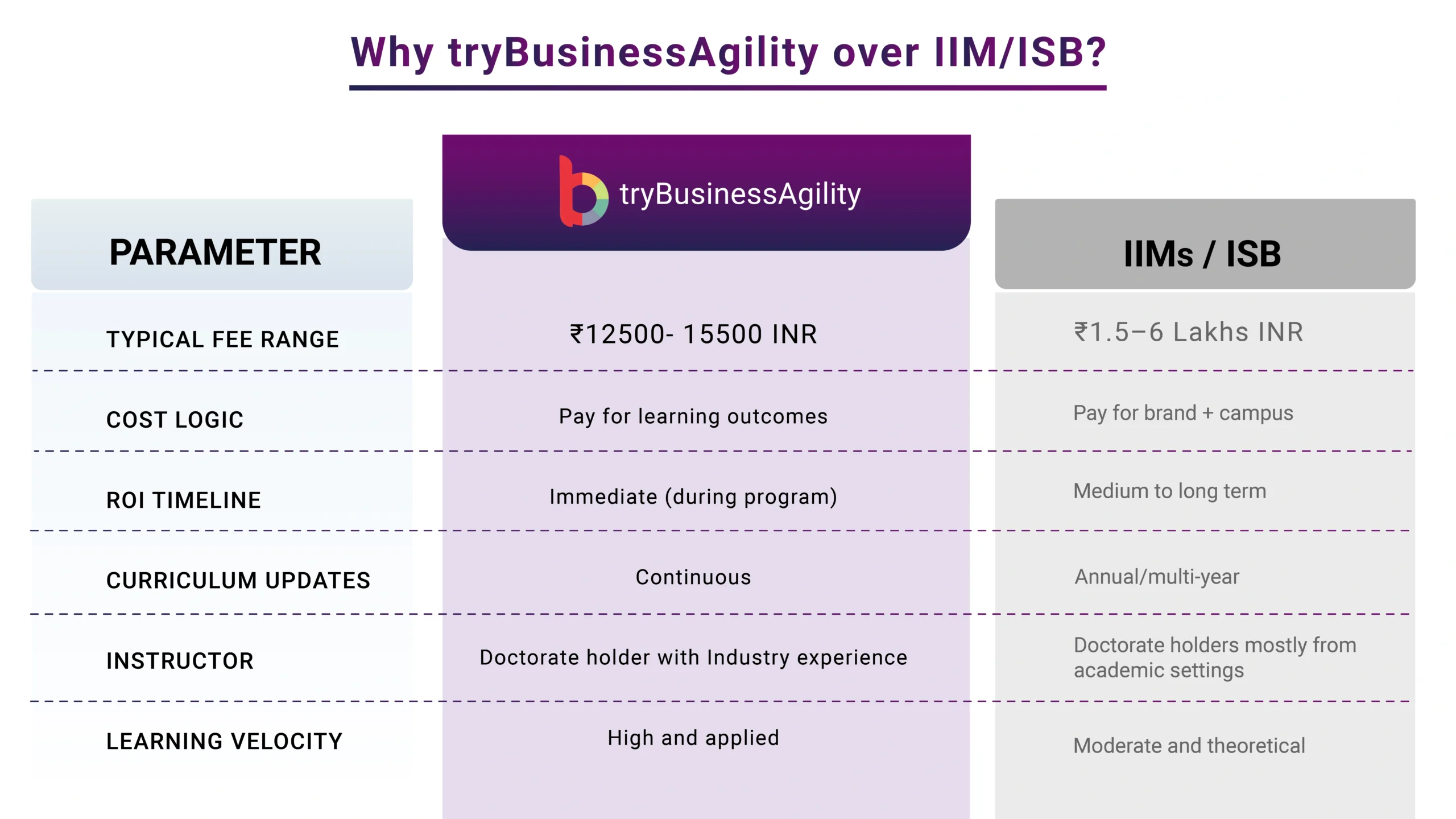
Choosing the right learning partner plays a critical role in the success of any executive education programme. tryBusinessAgility has built its reputation by focusing on practical outcomes, leadership capability, and organisational impact rather than academic formality.
Certification
The Digital Transformation Certification Training concludes with a recognised certification that reflects applied learning and leadership readiness. The certification signals that participants understand how digital initiatives influence strategy, execution, and organisational capability.
Certification Recognition:
Participants who complete the programme receive an official Digital Transformation Certification issued by tryBusinessAgility. The certification carries value across industries and roles due to its practical orientation and leadership focus.
Organisations recognise the certification as evidence of readiness to contribute meaningfully to digital initiatives, transformation programmes, and strategic discussions.
Professional Outcomes for Participants:
Participants complete the programme with stronger clarity on digital priorities and decision-making. The course supports improved confidence during leadership conversations related to technology, data, and change initiatives.
Professionals gain the ability to assess digital proposals, ask relevant questions, and align initiatives with business goals. This clarity supports more effective contribution in senior meetings, reviews, and planning sessions.
Organisational Impact:
Organisations benefit when certified professionals bring structured thinking into transformation efforts. The programme supports better alignment across leadership levels, reduced execution friction, and clearer accountability.

- Certificate Title: AI & Digital Transformation Strategist
- Issued by: tryBusinessAgility
- Format: Digital and printable PDF
- Authentication: Includes unique ID for online verification
Career and Role Advancement:
The certification supports career growth by strengthening leadership credibility. Participants often find themselves better prepared for expanded responsibilities related to strategy, transformation, and organisational change.
The learning experience adds depth to professional profiles without limiting relevance to a single industry or role.
Long-Term Learning Value:
Beyond immediate outcomes, participants gain frameworks and perspectives that remain useful as organisations continue to evolve. The certification represents a foundation for ongoing learning rather than a one-time achievement.
Earn Your Badge
Upon successful completion of the AI & Digital Transformation Strategist program, participants receive a digital badge in addition to the official certificate. This badge serves as a visual credential that represents your verified skills and strategic knowledge.
Where You Can Use the Badge
- Add it to your LinkedIn profile under certifications
- Share it on social media or email signatures
- Display it on your resume or personal website
The badge is issued through a secure digital platform, making it easy for employers and peers to verify your achievement instantly. It helps you stand out in job applications, internal promotions, and client-facing roles.
Program Format and Duration
The Digital Transformation Certification Training is structured to support working professionals who manage demanding schedules. The programme balances depth of learning with flexibility, allowing participants to engage fully without disrupting professional responsibilities.
Learning Format
The programme is delivered through live instructor-led online sessions. These sessions encourage interaction, discussion, and peer learning rather than passive listening. Participants engage directly with faculty and peers, creating a classroom experience in a virtual setting. Sessions include guided discussions, case analysis, and practical exercises. This format supports application of concepts to real organisational challenges faced by participants.
Session Structure
Each session focuses on a specific theme aligned with the curriculum. Sessions are structured to maintain attention and engagement through varied activities and discussion formats. Participants receive supporting materials that reinforce learning without overwhelming content volume. Time is allocated for reflection and questions, allowing deeper understanding of key ideas.
Programme Duration
The duration typically ranges between 8 and 12 weeks, depending on the selected learning track and delivery schedule. This duration allows sufficient time to absorb concepts, apply learning, and reflect on outcomes. Sessions are spaced to support continuity while respecting professional commitments. Participants can plan attendance in advance with clear scheduling information.
Learning Commitment
The programme requires active participation to gain full value. Participants are encouraged to engage in discussions, share experiences, and reflect on their organisational context. Between sessions, light reflection or reading may be suggested to reinforce learning. The overall time commitment remains manageable for senior professionals.
Participant Engagement
Participants join sessions from any location, making the programme accessible across cities and regions. Technical support and programme coordination ensure a smooth learning experience throughout the duration. This program helps to understand digital transformation's importance and the potential it has in this feild.
Corporate and Team Training Option
Organisations often achieve better outcomes when digital transformation learning extends beyond individuals. The Corporate and Team Training option supports structured capability building across leadership groups, functional teams, and transformation offices.
Organisational Alignment and Shared Understanding
Corporate training enables teams to develop a shared view of digital priorities, language, and expectations. When leaders and managers learn together, decision-making improves and execution becomes more consistent.
The programme supports alignment across strategy, operations, technology, finance, and HR teams. This shared understanding reduces friction and speeds up transformation efforts.
Customised Delivery for Business Context
Corporate training programmes are aligned with organisational goals, industry context, and maturity level. Learning sessions reflect internal challenges, market conditions, and strategic objectives.
While the core framework remains consistent, examples and discussions relate closely to the organisation’s environment. This approach supports direct application after the programme.
Leadership and Capability Development at Scale
Team-based participation builds leadership capability across multiple levels simultaneously. Executives, leaders, and managers develop a common approach to digital initiatives while understanding role-specific responsibilities.
This structure supports smoother execution and stronger accountability across departments.
Support for Transformation Programmes
Organisations running active transformation initiatives benefit from focused learning aligned with ongoing programmes. Teams gain clarity on governance, measurement, and execution practices that support delivery.
The training helps teams address issues related to prioritisation, stakeholder engagement, and progress tracking.
Flexible Delivery Options
Corporate programmes can be delivered through live virtual sessions or blended formats. Scheduling aligns with organisational availability and project timelines.
tryBusinessAgility’s programme team works closely with organisations to ensure learning integrates smoothly with business priorities.
Meet Your Faculty
The strength of the Digital Transformation Certification Training lies in the experience and credibility of its faculty. The programme is led by educators and practitioners who have spent years working inside organisations, delivering change, and building capability across teams. Their approach reflects real challenges faced by leaders rather than academic theory.The strength of tryBusinessAgility’s AI & Digital Transformation Strategist program lies in the experience and credibility of its instructors. The faculty members are not just educators—they are active practitioners with deep knowledge of business, technology, and transformation strategy.

Dr. Venkatesh Rajamani
Dr. Venkatesh Rajamani brings deep experience in delivering working software through short, feedback-driven cycles. His professional journey spans large banking, payments, telecom, and product organisations where digital initiatives operate under strict regulatory, operational, and scale constraints.
As a PhD scholar at Girne American University, his academic work complements hands-on delivery experience. His sessions focus on how managers influence outcomes through decision-making, prioritisation, and leadership behaviour. Participants benefit from clear explanations of agile delivery, platform thinking, and execution discipline from a business leadership viewpoint.
Dr. Venkatesh Rajamani supports managers in understanding how technology teams work, how delivery risks emerge, and how leadership actions either accelerate or slow progress. His teaching style emphasises clarity, accountability, and practical insight.
- Areas of Expertise: Agile Transformation, AI Strategy, Business Agility
- Industry Experience: Banking, Telecom, Payments, Software
- Teaching Style: Case-based, application-driven, highly interactive
Arunvignesh Ramakrishnan
Arunvignesh Ramakrishnan is a trainer and leadership coach who works closely with teams and organisations to build capability and resilience. His work focuses on leadership behaviour, team dynamics, and organisational learning during periods of change.
In this programme, Arunan brings strong focus on people aspects of digital initiatives. Participants explore how communication, trust, and leadership presence influence adoption and performance. His sessions help managers recognise patterns of resistance and respond with confidence and empathy.
Arunvignesh Ramakrishnan’s coaching background ensures that learning remains reflective and action-oriented. Managers gain tools to support teams through uncertainty while maintaining accountability and performance.
- He has coached teams across industries including banking, telecom, healthcare, and IT services.
- Known for his engaging and outcome-focused facilitation style, Arunvignesh Ramakrishnan helps professionals connect theory to practice through clear examples and interactive learning.
- He is passionate about helping organisations become capable and resilient through people-centered innovation.

Program Pricing and Enrollment
AI & Digital Transformation Strategist
-
Date: 29 Nov, 2025
-
Time: 10.00 AM to 5.00 PM IST
-
Mode: Virtual Online
-
Trainer: Dr. Venkatesh Rajamani
The pricing structure reflects the depth of learning, faculty involvement, and ongoing participant support provided throughout the programme. The enrollment process remains clear and accessible for individual professionals and organisations.
Programme Pricing
- Pricing varies based on delivery format, cohort size, and learning support options. Details are shared transparently during the enrollment process. Corporate pricing is structured separately based on team size and delivery requirements.
Simple Enrollment Steps
- Interested participants begin by completing the registration form available on the programme page. After registration, the admissions team shares programme details, schedules, and payment options.
Payment Options
- Flexible payment plans support working professionals. Options include one-time payment and instalment plans based on programme structure. Corporate participants receive consolidated invoicing where required.
Seat Confirmation
- Enrollment is confirmed upon successful payment. Participants receive access to programme materials, session schedules, and joining instructions before the course begins.
Participant Support
- The programme support team assists with enrollment queries, scheduling clarification, and access to learning resources. Support continues throughout the programme duration.
Reviews
Sascha Guenther
Director, Global Tech Firm
Great introduction to Design Thinking.
We had a great group with lots of good energy and our Coach Venkatesh guided us through the session with great enthusiasm and passion for the topic.
Highly recommended!
- April 26, 2025
Ashok Kumar Kanuparthi
Strategy Lead, Regional Enterprise
It was a wonderful session.
It was a wonderful session. I gained more insights on design thinking. The agenda was well planned. It would have been more exciting had been in-person training. Many a thanks to the trainer Mr. Rajamani.
- February 01, 2025
Isai Venthen Ramaiah
Agile Coach, Telecom Sector
Design Thinking Professional Workshop
Design Thinking Professional Workshop is interactive and activity filled. Trainer Venkatesh Rajamani has diversified knowledge on business and technology domains . It’s helpful to leverage my business knowledge ! Thanks team tryBusinessAgility !
- January 23, 2024
Rajeswari Radhakrishnan
CTO, Healthcare Solutions Provider
Digital Transformation from trybusinessagility
I had the opportunity to take up the Digitial Transformation Foundation course from TryBusinessagility. The course covered all the fundamentals of Digital transformation. The case studies presented by them were very helpful. The coaches had extensive knowledge on the subject which was very evident from the way the course was taught.If you are thinking of Digital Transformation for your organization and want to know the success pillars then I would highly recommend this course.
- August 23, 2024
Vignesh brb
Director, Global Tech Firm
Design Thinking - Is a Strong Common Sense
Thanks to my trainer Venkatesh Rajamani. It was extremely engaging with a perfect mix of theory, real-time stories, and many Break out sessions to actually "Think". I have always thought that design thinking is for designers in the market. However, this workshop shaped my thinking perspective. More than a skill, I became confident in "How to think" and bring a solution with Empathy. Loved it.
- December 22, 2024
Manoj Sharma Manish
Customer Experience Manager, Retail Group
Design Thinking Professional
I had great learning from Trybusinessagility on Design thinking with Venkatesh Rajamani. His real-time examples and the way he taught each module of the workshop helped me gain knowledge on how to tackle wicked problems and how design thinking can help solve problems and provide solutions to unclear problems. I would strongly recommend Trybusinessagility and it can be a game changer for your career.
- December 22, 2024
FAQs
Who can join the Digital Transformation Certification Training?
Professionals across leadership levels can join the programme. Executives, leaders, managers, business owners, consultants, and corporate teams find the course relevant regardless of industry.
Is prior technical knowledge required for this programme?
Technical background is not required. The course explains digital and technology concepts from a business and leadership perspective.
How is this programme different from other digital courses?
The programme focuses on leadership judgement, business alignment, and execution clarity. Learning stays practical and avoids tool-driven instruction.
What learning format does the programme follow?
The programme uses live instructor-led online sessions with interactive discussions, case analysis, and peer learning.
How long does the programme take to complete?
Programme duration usually ranges between 8 and 12 weeks depending on the selected learning track and schedule.
Does the certification carry professional value?
Yes. The certification signals readiness to contribute to digital initiatives and leadership conversations across organisations.
Can organisations enrol multiple participants together?
Organisations can enrol teams through the corporate and team training option. Group participation supports alignment and shared understanding.
Will participants receive learning materials?
Participants receive curated learning resources that support session topics without excessive volume.
Is there post-programme engagement or alumni access?
Participants gain access to the alumni network, enabling continued peer connection and knowledge sharing.
How can I apply for the programme?
Interested participants can submit an online application and speak with a programme advisor to confirm fit and enrolment details.
If you have any additional questions, our admissions team is available to assist before, during, and after enrollment.